Disney College Program Housing Guide 2026: Rent, Room Types, Parking and Fees

Flamingo Crossings Village can look almost suspiciously easy from the outside. The apartment is furnished. Transportation is available. Rent comes out of your paycheck. There are pools, gyms, events and a ready-made population of people who also just arrived in Florida carrying too much luggage and not quite enough certainty.
Then the numbers begin to arrive.
There is a program fee. There is weekly rent. There may be a parking fee. Your preferred room is not guaranteed. A private bedroom costs more, if you get one at all. And the word "included" has a way of sounding more generous until you remember that food, detergent, bedding, transportation outside the bus system and most of ordinary life still cost money.
None of that makes Flamingo Crossings Village a bad deal. For many Disney College Program participants, it is the most practical housing choice available. It simply deserves to be understood as a real financial decision, not a colorful extension of the acceptance email.
This guide breaks down the official 2026 costs, the room layouts, parking, payroll deductions and the catches that tend to matter after the excitement wears off. Official Disney and Flamingo Crossings information is separated from participant-reported details so you can see where the facts end and the useful online chatter begins.
The quick answer: 2026 DCP housing at a glance
Cost or rule | 2026 figure | What it means |
Disney Program fee | $467 total | Nonrefundable and paid in stages for domestic College and Culinary participants |
Flamingo Crossings housing | $227 to $275 per week | Official Disney range; exact cost depends on assigned room type |
Monthly budgeting equivalent | About $984 to $1,192 | Useful for comparison only; housing is charged weekly |
Parking hangtag | $150 | Limited, first come and not guaranteed |
Parking after an extension | $75 renewal | Applies when a participant extends and keeps a vehicle onsite |
Utilities | Included, with an electricity cap | Wi-Fi, water, waste and electricity are included under the published terms |
Furniture | Included | Apartments include core furniture, appliances and an in-unit washer and dryer |
Meals | Not included | Groceries, takeout and every ill-advised snack run are yours |
The cleanest official answer is this: Disney lists 2026 Flamingo Crossings Village housing at $227 to $275 per week. That works out to roughly $984 to $1,192 per month when converted using 52 weeks divided by 12 months.
That monthly figure is a budgeting translation, not the way the charge appears. Rent is assessed weekly. Some months effectively contain more weekly housing charges than others, which is exactly why multiplying the weekly price by four can leave your budget looking smarter than it really is.
Disney publicly confirms the range. The exact room-by-room prices discussed later in this guide come from current participant reports and should be verified against your own DORMS information and housing agreement before you make a decision.
First, what Flamingo Crossings Village actually is
Flamingo Crossings Village, usually shortened to FCV, is the participant housing community used for Disney Programs in Central Florida. It is owned and managed by American Campus Communities, not operated like a traditional Disney resort hotel. The East and West campuses sit roughly a mile west of Walt Disney World property in the Winter Garden area.
The apartments are furnished and built around shared living. Disney says the community offers two-bedroom and four-bedroom apartments with a combination of shared and private bedroom or bathroom arrangements. No layout is a private one-bedroom apartment. A bedroom may hold up to two residents, and an apartment may hold up to four.
That distinction matters. You are not paying only for a room. You are paying for a simplified system around the room: furniture, basic utilities, program transportation, maintenance support, community staff and amenities that already exist when you arrive.
You are also accepting less control than you would usually have in a conventional apartment search. Your housing dates follow your program dates. Your room preference is not a promise. Your neighbors are other participants. Your home and your program can feel tightly braided together, sometimes in a wonderful way and sometimes in the way wet shoelaces are tightly braided together.
FCV can make a first move to Orlando dramatically easier. It can also feel expensive once you translate a weekly charge into a monthly one and remember that you are still sharing the apartment. Both statements can be true.
The 2026 costs you face before arrival
For domestic Disney College Program and Culinary Program participants, Disney lists a $467 nonrefundable program fee. It is not one mysterious lump of money disappearing into a castle-shaped vault. The published 2026 schedule divides it into two payments if you enroll in Flamingo Crossings housing:
$240 after acceptance covers program participation, administration and scheduled events.
$227 about three weeks before arrival is tied to FCV housing.
Of that second payment, $75 is a housing administration fee.
The remaining $152 is applied toward the first week of housing.
The important word is nonrefundable. Disney states that these fees are also nontransferable and that all costs are subject to change. Read the deadline in your own offer and DORMS materials. Missing a payment window is a terrible way to discover how seriously an automated system takes a date.
The second payment is also easy to misread. It does not mean your first week of housing costs only $152. It means $152 of the advance payment is credited toward that first week. If your assigned weekly rate is higher, the remaining amount still has to be covered.
Parking is separate. If you register a vehicle and receive the option to buy a hangtag, the published cost is $150. That pushes the up-front outlay for a domestic participant living at FCV and bringing a car to $617, before travel, food, bedding or the small mountain of things every move somehow requires.
Weekly rent: the official range and the reported room rates
Disney's official 2026 housing page gives a weekly range of $227 to $275. It does not publicly break that range into a price for every floor plan on the fee page.
Current 2026 participant discussions consistently report the following room-by-room amounts. Treat these as a useful planning guide, not a substitute for the rate shown in your own enrollment or housing documents.
Room type | Participant-reported weekly rate | Approximate monthly equivalent | Privacy level |
2x2 | $227 | About $984 | Shared bedroom and shared bathroom |
4x2 | $251 | About $1,088 | Private bedroom and shared bathroom |
4x4 | $275 | About $1,192 | Private bedroom and private bathroom |
The spread from the reported 2x2 rate to the 4x4 rate is $48 per week, or about $208 per month. Across a 20-week program, that difference would be roughly $960. Across 24 weeks, it would be about $1,152.
That is the price of privacy in plain numbers.
Whether it is worth paying depends on how you sleep, how much quiet you need and whether the extra cost would leave the rest of your budget gasping for air. A private room can be a genuine quality-of-life upgrade. It is not a bargain if you spend the program anxious about groceries.
Room types without the brochure fog
The floor-plan names are compact. Real life inside them is not. Every layout can house four participants, but the amount of privacy changes sharply.
The 2x2: cheapest, social and very shared
A 2x2 generally has two bedrooms and two bathrooms for four residents. Two people share each bedroom, and those two usually share the bathroom connected with that side of the apartment.
The financial argument is simple. At the current participant-reported rate, it is the least expensive FCV option. You still receive the same broad community benefits, furnishings, utilities and transportation access while keeping an extra $24 to $48 per week compared with the reported private-bedroom layouts.
The human argument is less tidy.
Sharing a bedroom with a stranger can become the best accidental friendship of your program. It can also mean alarms at different hours, phone calls when you are trying to sleep, wet towels with no known owner and a philosophical disagreement about whether an overhead light should ever be used after midnight.
Participant discussions tend to split along predictable lines. Some people say different work schedules gave them more alone time than expected. Others say the lack of a door they could close behind themselves became exhausting. Light sleepers and people who need reliable solitude should take that seriously. Optimism is useful. Earplugs are more useful.
The beds in two-bedroom layouts are listed as Twin XL, so buy the correct sheets. A regular twin fitted sheet can turn move-in night into an unnecessary wrestling match.
The 4x2: the practical middle ground
A 4x2 generally provides four private bedrooms and two bathrooms. Each participant has a bedroom, while two residents share one bathroom.
For many people, this is the sensible compromise. You can close your bedroom door. You can take a call without broadcasting it to a roommate. You can come home from a difficult shift and stare at the ceiling in peace. Yet you avoid the highest reported weekly rate.
The bathroom is still shared, which means schedules and basic courtesy matter. But sharing a sink and shower is a different proposition from sharing the room where you sleep, change clothes, study and attempt to recover from a closing shift.
At the current participant-reported figure of $251 per week, the 4x2 is about $24 more each week than a 2x2. That is roughly $104 per month for a bedroom door of your own. For a participant who values privacy but cannot justify the 4x4 premium, the math is easy to understand.
There is one catch, and it is not small: Disney and FCV do not guarantee that preference. Four-bedroom inventory is described as extremely limited. Wanting the middle ground does not create more buildings.
The 4x4: maximum privacy, maximum price, minimum certainty
A 4x4 generally provides four private bedrooms and four private bathrooms. You still share the kitchen and living room, but your bedroom and bathroom are your own.
This is the closest FCV comes to conventional roommate living. It offers the best chance to control your sleep, your personal space and the condition of the bathroom. For participants with sensory needs, demanding schedules or a strong preference for privacy, that can have real value.
The reported 2026 rate is $275 per week, the top of Disney's official range. That is about $1,192 per month on a 52-week conversion. It is not cheap, particularly for one bedroom in a four-person furnished apartment.
The bigger problem may be availability. FCV says four-bedroom layouts are extremely limited, and private bedroom or bathroom preferences are not guaranteed. Build a budget that can handle the room you want, but build an emotional backup plan for the room you may receive.
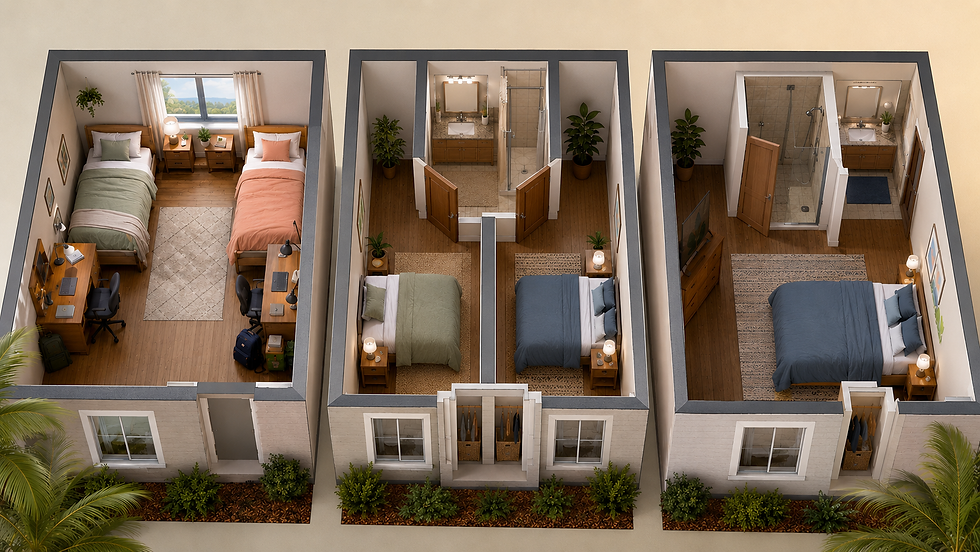
Illustration only. It shows the privacy tradeoff between common room arrangements, not an official Flamingo Crossings Village floor plan.
Room preferences are preferences, not promises
Housing enrollment takes place through DORMS. Participants must complete the enrollment or decline process by the deadline for their arrival group. Domestic College and Culinary participants may be able to decline FCV housing during that window. International participants are not permitted to opt out under the published policy.
If you enroll and the window closes, Disney states that you are obligated to the housing arrangement for your program dates. This is not a box to check casually while half-watching television.
DORMS may let you indicate room and gender preferences, but the options available can vary. Disney offers mixed-gender housing, and accommodation requests are handled through a separate process during enrollment. FCV says it generally contacts participants about housing accommodations within four weeks of arrival.
Do not assume you can choose a roommate because a participant from a previous season could. Recent online discussions show that roommate-linking options have varied by arrival group. The only reliable choices are the ones actually presented in your DORMS invitation.
The same caution applies to room size and furniture plans. Participant reports suggest that rooms can differ slightly by building position and layout. Do not buy a bulky desk, chair or storage system before you have seen the room. The internet is full of people trying to solve tomorrow's space problem by buying today's plastic drawers.
Your housing assignment and key information are typically provided during the arrival process. Until then, a preference is a request, not a lease promise.
Parking: the $150 question
Bringing a car can make Orlando life far easier. It can also add another fee before you have earned your first paycheck.
The 2026 parking hangtag costs $150. Disney says hangtags are limited, sold on a first-come basis and not guaranteed. Registering a vehicle during housing enrollment does not manufacture a parking space. Only participants who register a vehicle and receive the purchase option can buy the hangtag.
Without a hangtag, you cannot keep the vehicle onsite at FCV. If you extend your program and continue parking there, Disney lists a $75 renewal fee.
The alternative is the complimentary Disney Programs bus system available to eligible FCV residents. For commuting to work, that can remove the expense and anxiety of driving every day. It is one of the strongest financial arguments for living at Flamingo Crossings.
But a work bus is not the same thing as complete transportation freedom. Think about groceries, medical appointments, airport trips, late-night errands and any part of Central Florida that is not on a convenient route. Delivery services and occasional rides can fill the gaps, but they are not free merely because they arrive through an app.
If you already own a reliable car, the decision is not just $150. Add insurance, fuel, maintenance and the risk of letting a vehicle sit in Florida heat. Then compare that total with the freedom you gain. If you do not own a car, a DCP is a poor excuse to rush into a loan simply because parking exists.
What your FCV housing cost includes
The weekly price is high enough that the included items deserve a fair accounting. According to Disney and FCV, residents receive:
Furnished common areas and bedrooms
A full kitchen with stainless-steel appliances
An in-unit washer and dryer
High-speed internet or Wi-Fi
Water, sewer, waste and electricity, subject to an electricity cap
Access to pools, fitness spaces and other community amenities
Community-desk and maintenance support
Disney Programs transportation for eligible residents
These inclusions remove much of the start-up friction that accompanies an ordinary apartment. You do not have to buy a sofa for a five-month program, open four utility accounts with new roommates or negotiate who gets stuck owning the dining table when everyone moves out.
The electricity cap is worth noticing. "Utilities included" does not mean four residents can treat the thermostat like a cryogenic experiment without consequence. Read the current housing agreement for the cap and any process for excess usage.
Amenities are real, but they should not carry too much weight in your budget. A pool is valuable if you use it. A fitness center is useful if you enter it. A beautiful common room you pass twice while carrying groceries is decoration.
What the weekly price does not solve
Housing gives you a furnished place to land. It does not provide a complete life.
Meals are not included. Neither are toiletries, medication, laundry detergent, cleaning products, bedding, towels, cookware you specifically prefer, entertainment or most transportation outside the program routes.
Disney's packing guidance recommends arriving with roughly $300 to $400 to cover expenses until around the third pay period, noting that it can take as long as three weeks to receive regular pay. Treat that amount as a floor, not a dare. Travel disruptions, medication, an urgent pair of work shoes or one spectacularly bad grocery calculation can consume it quickly.
For bedding, Disney's current packing list says two-bedroom apartments use Twin XL linens and four-bedroom apartments use Full XL linens. Full XL sheets are less common than standard full sheets, so check the current guidance before you buy.
FCV also does not make personal-property risk disappear. Confirm whether you need renters insurance or other coverage under your current agreement. The building's coverage and your belongings are not automatically the same thing.
Most importantly, the weekly charge does not guarantee the room type you prefer. You are paying for assigned housing within the program system. That distinction is the heart of the decision.
How payroll deduction really works
For most FCV participants, housing costs are automatically deducted from the weekly Disney paycheck. This is convenient. It is not magic.
Disney states that participants are responsible for housing charges for every Sunday-through-Saturday week of their program. If a paycheck is not large enough to cover the full housing amount, the unpaid balance is still owed.
That can happen during a short workweek, an unpaid absence or another period when earnings are lower than expected. Automatic deduction makes the payment quieter. It does not make the obligation smaller.
The practical move is to keep housing in your budget even though you never manually transfer the money. Start with gross pay, subtract taxes, subtract the weekly housing charge and only then decide what is available for food, transportation and everything else.
Do not use "weekly rent times four" as your monthly budget. A year contains 52 weeks, not 48. Use the monthly equivalents in this guide, or keep your entire budget weekly so the rhythm matches the deduction.
There is also a psychological catch. Money removed before it reaches your bank account can feel less expensive because you never see it leave. Your checking balance may look clean while your housing cost remains very real. Convenience is not a discount.
Should you choose Flamingo Crossings Village?
There is no universally correct housing answer. There is only the option that fits your program, budget and tolerance for shared life.
FCV is strongest when you want simplicity
Flamingo Crossings makes the most sense if this is your first move away from home, you are arriving without local knowledge, you want program transportation or you value living among other participants.
It is also useful when your program length makes a conventional lease awkward. Furniture, utilities and program-aligned dates remove several problems at once. If you arrive by plane with two suitcases, that simplicity is worth real money.
The social side should not be dismissed. Living near other participants can make it easier to meet people, attend events and build a community quickly. A program can be lonely even when thousands of people are technically nearby. FCV lowers the distance between strangers.
Think carefully when privacy or control is nonnegotiable
FCV deserves more scrutiny if you must have a private bedroom, need to choose exactly who you live with, want full control over lease dates or prefer to keep home separate from the program.
It may also be a poor fit if your housing needs include a partner or family member who is not an eligible participant, a pet outside an approved accommodation or a setup that the available shared layouts cannot provide. Confirm the current rules for your situation rather than assuming an exception.
Off-site housing can offer more control, but it replaces FCV's simplicity with a lease, deposits, furniture, utilities, transportation planning and qualification requirements. The cheaper advertised rent is not automatically the cheaper life.
Compare complete systems. Anything less is brochure math.
Before you click Enroll in DORMS
Read your current offer, DORMS instructions and housing agreement. Then answer these questions honestly:
Can your budget handle the top of the official $227 to $275 weekly range?
Would sharing a bedroom materially affect your sleep, health or ability to work?
If your preferred layout is unavailable, will you still accept the assignment?
Do you need to submit a housing accommodation request during enrollment?
Are roommate-linking options actually shown for your arrival group?
Will you bring a car, and do you understand that parking is limited?
If you skip the car, can the bus system and occasional paid rides cover your real life?
Do you have enough cash for food and essentials before regular pay arrives?
Have you checked the correct bedding size for your likely apartment type?
If you are considering off-site housing, have you compared furniture, utilities, deposits and transportation rather than rent alone?
If one of those answers is "I do not know," stop and find out. Housing decisions become expensive when uncertainty dresses itself up as enthusiasm.
The bottom line
Flamingo Crossings Village is not cheap, and it is not a scam. It is a furnished, transportation-supported housing system built around a temporary program. You pay for convenience, community and fewer moving parts. You give up some privacy, choice and control.
The official 2026 range is $227 to $275 per week. The reported room rates make the tradeoff plain: less privacy costs less, and more privacy costs more, assuming the room is available.
Choose the 2x2 because the savings matter and you can live with a roommate. Prefer the 4x2 if a bedroom door is worth the middle price. Request the 4x4 if maximum privacy justifies the premium. But do not confuse a request with a guarantee, and do not build a budget that survives only if every preference goes your way.
The best housing choice is the one that still makes sense after the welcome email stops glowing.
Sources and methodology
Official facts and 2026 figures were checked on August 1, 2026. Disney notes that fees, policies and availability can change, so participants should confirm all amounts in their own offer, DORMS materials and housing agreement.
Participant discussions were used only for clearly labeled room-by-room rate reports and practical observations about privacy, room variation and roommate preferences. They were not treated as official policy.


Comments